

Advancing Integration of Care (November 4 & 9, 2026)
Current Status
Price
Get Started
Course Credit
The following credits are available for this course:
| AMA PRA Category 1 Credits™ (MD, DO, NP, PA) | 5.0 hours |
| APA Continuing Education Credits (Psychologist) | 5.0 hours |
| Contact Hours (Nurse) | 5.0 hours |
| CDR CPEUs (Registered Dietitian) | 5.0 hours |
For MOC Credit: You will receive an e-mail from Q-Stream with the MOC II questionnaire. Please log in to your ABP, ABIM, ABA, and/or ABS profile to view your credit within 10 business days of completing the Q-Stream. Please note that you have until December 26, 2025 to complete the MOC II questionnaire on Q-Stream and receive credits.
(Note: a course evaluation is required to receive credit for this course.)
Overview
Boston Children’s Hospital is happy to partner with Optum MA for the 15th annual Advancing Integration of Care Course. This course is developed specifically for Optum MA clinicians and will be held on two separate evenings on Wednesday, November 4th, and Monday, November 9th. The course format is a virtual lecture via Zoom with time for questions and answers from learners.
The relationship Boston Children’s has developed with Optum MA is part of the foundation of the collaborative relationship. Each year, Optum MA reviews its strategic priorities for clinical care to inform the topics for the event. This course offers an opportunity for primary care clinicians to learn with subspecialists with the goal of improving patient and family-centered care integration.
Course Format
This year’s course will be fully digital and be presented online, via Zoom.
At the conclusion of this educational program, learners will be able to:
Pediatric Sleep Disorders: OSA, Sleep Studies, and Behavioral Sleep Counseling
- Recognize the signs and symptoms of obstructive sleep apnea (OSA) in children and apply current recommendations for sleep screening at well-child visits.
- Describe indications for pediatric sleep studies. Who orders these studies?
- Discuss current management options for children with persistent OSA following tonsillectomy and adenotonsillectomy.
- Apply evidence-based behavioral sleep counseling strategies to address common pediatric sleep concerns in the primary care setting.
Asthma Update: Rethinking Albuterol Monotherapy Under the New GINA Guidelines
- Describe the rationale behind the updated GINA recommendation against SABA (albuterol) monotherapy, including the evidence linking frequent SABA use to airway inflammation, exacerbations, and increased mortality risk.
- Review SMART (Single Maintenance and Reliever Therapy) for the general PCP.
- Apply current GINA-based treatment strategies to construct an asthma action plan for a child with mild intermittent asthma and exercise-induced symptoms.
- Update PCPs on new developments in management of asthma. What are pulmonologists doing today that we might not be aware of.
Bathroom Mishaps: A Urological Approach to Dysfunctional Voiding and Bedwetting
- Differentiate dysfunctional voiding from other causes of daytime urinary incontinence and nocturnal enuresis in children.
- Describe the relationship between bladder and bowel dysfunction (BBD) and its effect on lower urinary tract symptoms.
- Apply first-line behavioral strategies—timed voiding, pelvic floor relaxation, and constipation management—in the primary care setting prior to specialist referral.
- Identify red-flag findings in a child with voiding dysfunction or enuresis that warrant referral to pediatric urology.
Dermatology Practical Pearls: Molluscum, Warts, Hemangiomas, and Eczema
- Identify clinical features of molluscum contagiosum and describe treatment options, including in-office cantharidin application, expected efficacy, and appropriate patient/family counseling on observation versus treatment.
- Describe current first-line and adjunct options for common cutaneous warts in children.
- Recognize infantile hemangiomas. Which hemangiomas do we refer to a specialist? Which hemangiomas are appropriate for PCPs to apply topical timolol and how? What is the natural history of these lesions?
- Eczema: when to prescribe topical tacrolimus in pediatric eczema management, including appropriate patient selection and counseling on side effects and off-label use.
Accreditation

In support of improving patient care, Boston Children’s Hospital is jointly accredited by the Accreditation Council for Continuing Medical Education (ACCME), the Accreditation Council for Pharmacy Education (ACPE), and the American Nurses Credentialing Center (ANCC), to provide continuing education for the healthcare team.
Physician
Boston Children’s Hospital designates this live activity for a maximum of 5 AMA PRA Category 1 Credits ™. Physicians should claim only credit commensurate with the extent of their participation in this activity.
Physician Assistant
Boston Children’s Hospital designates this live activity for a maximum of 5 AMA PRA Category 1 Credits ™. Physician Assistants should claim only credit commensurate with the extent of their participation in this activity.
Nurse
Boston Children’s Hospital designates this activity for 5 contact hours for nurses. Nurses should only claim credit commensurate with the extent of their participation in the activity.
Dietitian
This activity has been approved for 5 CPEUs. Completion of this RD/DTR profession specific or IPCE activity awards CPEUs (One IPCE=One CPEU). RDs and DTRs are to select activity type 102 in their activity log. Sphere and Competency selection is at the learners discretion.
MOC II
Successful completion of this CME activity, which includes participation in the activity, with individual assessments of the participant and feedback to the participant, enables the participant to earn:
5 MOC points in the American Board of Pediatrics (ABP) Maintenance of Certification (MOC) program.
Disclosures
Boston Children’s Hospital adheres to all ACCME Essential Areas, Standards, and Policies. It is Boston Children’s policy that those who have influenced the content of a CME activity (e.g. planners, faculty, authors, reviewers and others) disclose all relevant financial relationships with commercial entities so that Boston Children’s may identify and resolve any conflicts of interest prior to the activity. These disclosures will be provided in the activity materials along with disclosure of any commercial support received for the activity. Additionally, faculty members have been instructed to disclose any limitations of data and unlabeled or investigational uses of products during their presentations.
The following planners, speakers, and content reviewers, on behalf of themselves, have reported the following relevant financial relationships with any entity producing, marketing, reselling, or distributing health care goods or services consumed by, or used on patients:
Please see the FAQs below for common questions about how to work through a course. If you have a question or issue that is not addressed in the FAQ, please use this form to submit a help request, or if your issue is urgent, call the CME office at: 617-919-9908.
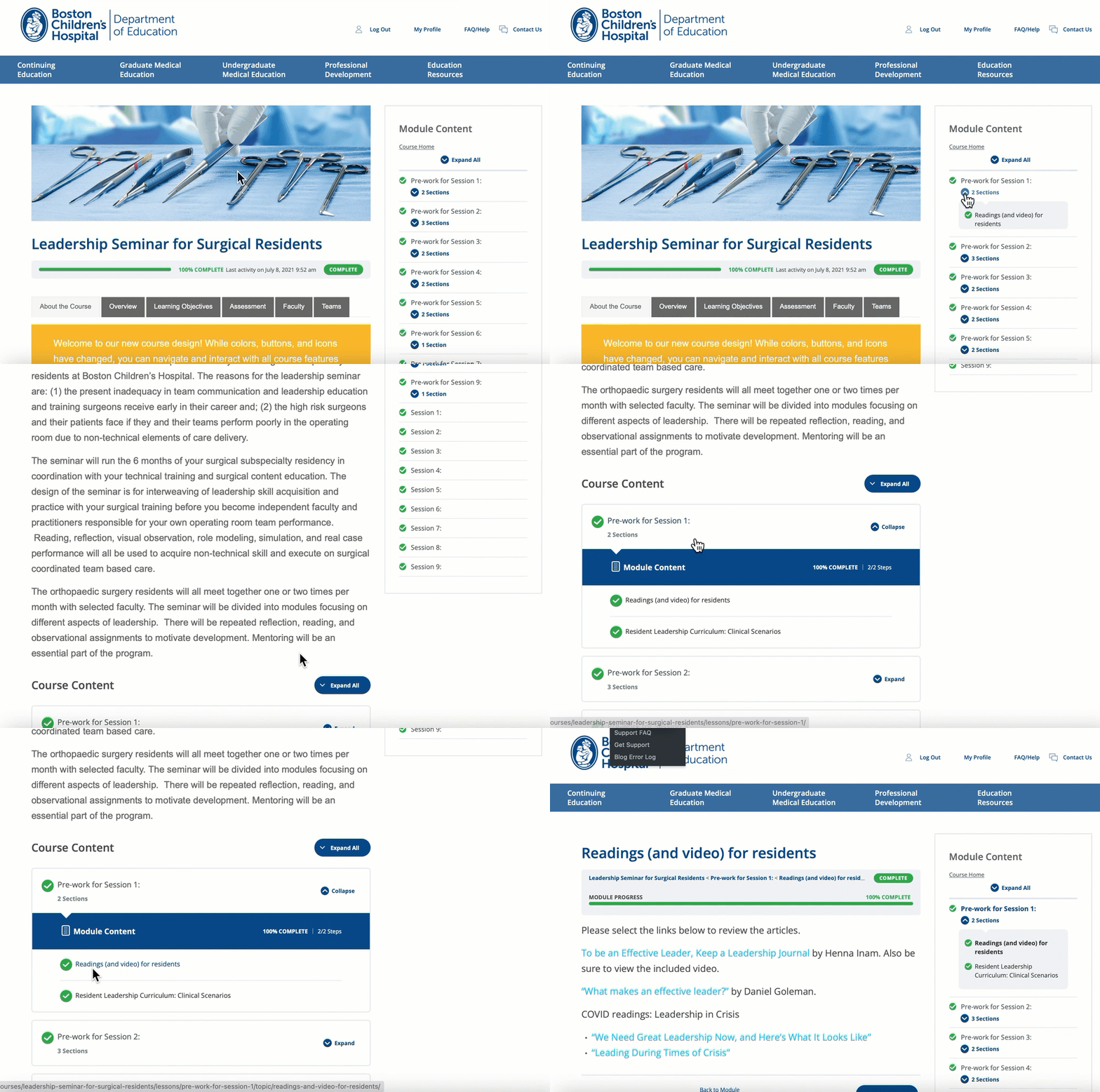
How do I navigate this course? There are two ways to access and navigate course content with the interactive table of contents: at the bottom of the main course page or in the sidebar on the right side of the page. Select the links in the table of contents to access the corresponding content. Depending on the course, access to content may be linear, in which case each content module or section can only be accessed if the prior ones are completed, or non-linear, in which case modules and sections can be accessed in any order. Use the breadcrumbs at the top of any course page to orient yourself within a course, or return to a previous course section or the main course page. How do I claim credit? If the course has been accredited, available credits will be displayed on the course home page. Select only those credits that apply to your profession, and click/tap “Apply Selection.” You may make your selection at any point while you are taking the course, or after you have completed it. How do I download a certificate? There are two ways to view/download your certificate: from within the course or from the course listing under your profile (select the document icon). In either case, you must have selected at least one available course credit type to generate a certificate. How do I view/print my transcript? You must be logged in to view your transcript. Select My Profile at the top of the page. If you do not see the transcript selector, be sure the Courses tab is selected. Select the type of credit and dates to include in your credit report. To include all credits from all time, leave the options blank. Select Download Transcript to view/download your transcript. Note each credit type in your transcripts starts a new page. How do I request a refund? Please email the CME Department to request a refund.How do navigate this course?
How do I claim credit for this course?
How do I download a certificate?
How do I view/print my transcript?
How do I request a refund?